RigIt: Precise Interactive Articulation of Objects in Images

1IIIT Hyderabad, 2Adobe Research, 3Boston University
SIGGRAPH Asia 2026
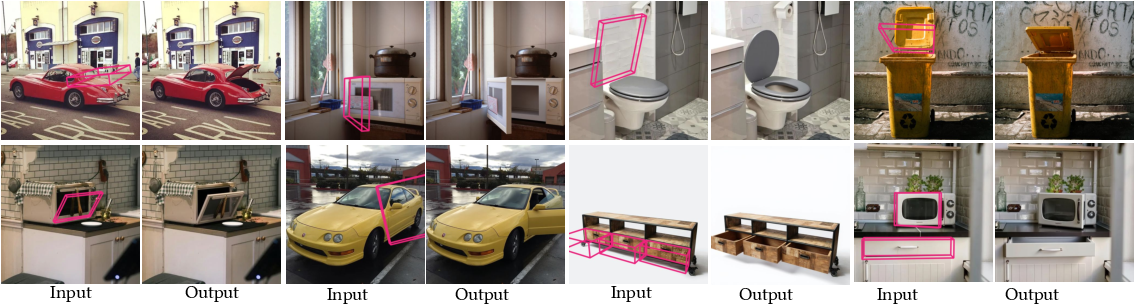
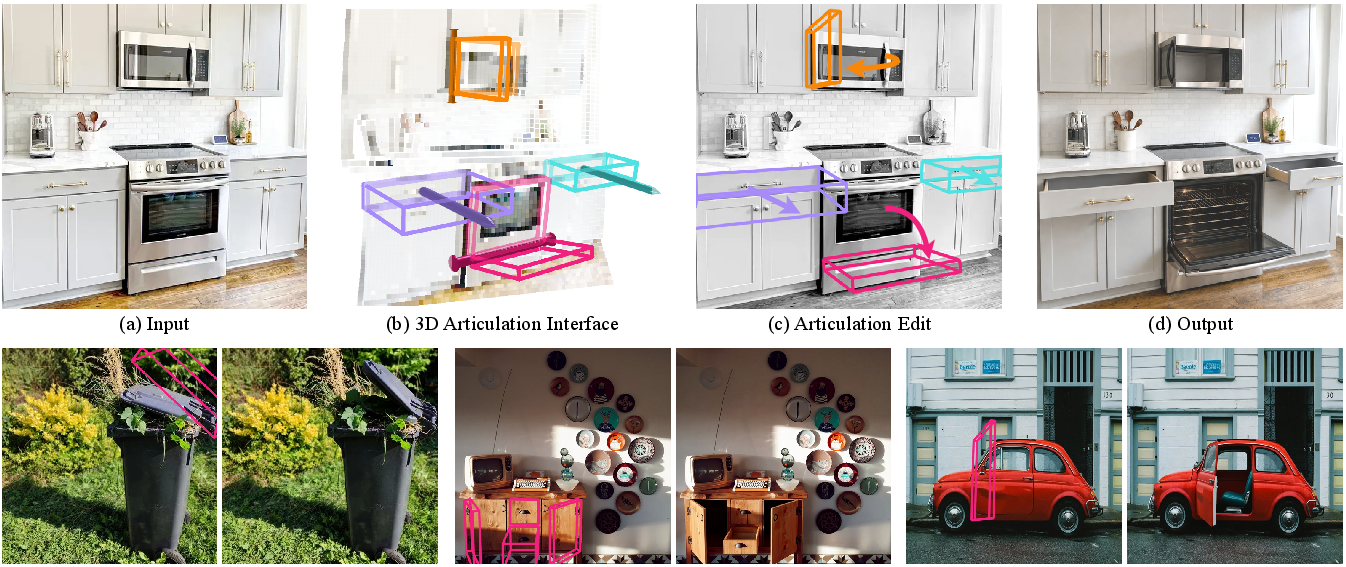
RigIt teaser: a kitchen scene whose microwave door, oven door and drawers are rigged as 3D boxes, articulated, and re-synthesized; plus in-the-wild results on a trash bin, a wooden cabinet and a car door.

Overview of articulation-based image editing with RigIt. Given a source image and a set of user-selected parts to articulate, our method produces a photorealistic edited image with the parts in a target articulation state while preserving identity, appearance, and scene context. Top: The user rigs movable parts of an input photograph (a) as 3D kinematic proxies (b), articulates them to the target state (c), and our diffusion model synthesizes the resulting image (d). Here the microwave door, oven door, and drawers are opened simultaneously, with shadows, lighting, and revealed interiors handled automatically. Bottom: RigIt generalizes to real photographs and to object categories absent from training. Each example shows the wireframe articulation overlaid on the input (left) and the resulting output (right): a trash bin, a wooden cabinet with multi-part motion, and a car door.
Abstract

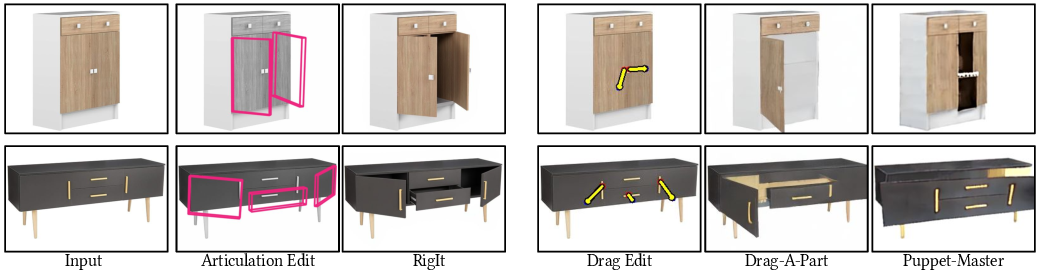
Editing articulated objects within a single image requires precise kinematic control—specifying exactly what moves, along which axis, and by how much. Existing text- and drag-based image editing methods provide only weak or ambiguous control over articulated object structure, often failing to localize the correct movable part or execute precise articulation extents, particularly under occlusion.

We propose RigIt, a novel framework that enables precise object articulation by directly “rigging” parts within a 2D image. Our method extracts the underlying geometry of a user-selected part to fit a 3D kinematic proxy, represented as an oriented bounding box (OBB). Users interactively manipulate this explicit 3D handle, which the system projects into a 2D wireframe conditioning signal. A fine-tuned diffusion model then processes this signal, guided by a localized articulation-aware loss, to generate photorealistic edits.

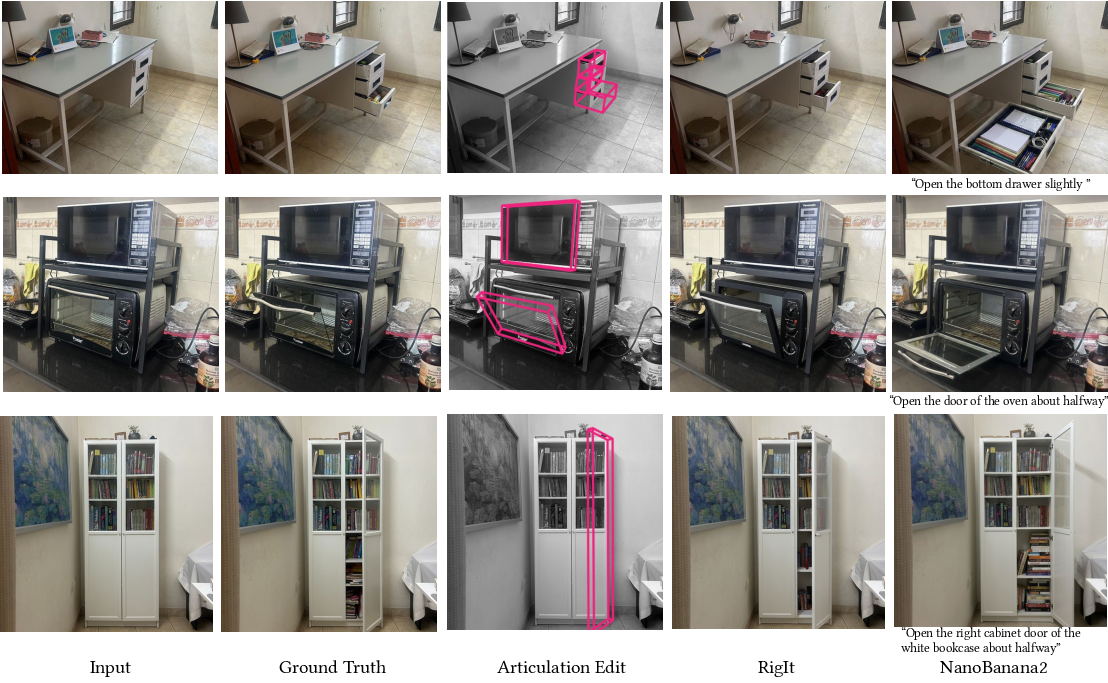
Remarkably, despite being trained exclusively on a small synthetic dataset of six categories, RigIt generalizes robustly to real-world, in-the-wild images and unseen object classes. Extensive evaluations on both synthetic and real-world benchmarks demonstrate that our approach significantly outperforms state-of-the-art text and drag-based baselines, achieving over 90% user preference for preserving articulation intent and scene consistency.

Examples

Real photographs edited with RigIt. Each animation first shows the articulation the user specified (the part's 3D proxy, its joint, and the motion extent) and then dissolves into RigIt's output. Photos: Unsplash, Pexels.

Method

A precise articulation needs three things: the part that moves, its joint (how it is allowed to move), and the motion extent (how far it moves). RigIt captures all three by rigging the part with a 3D proxy, then projects the articulated proxy into a 2D wireframe that guides a diffusion model.

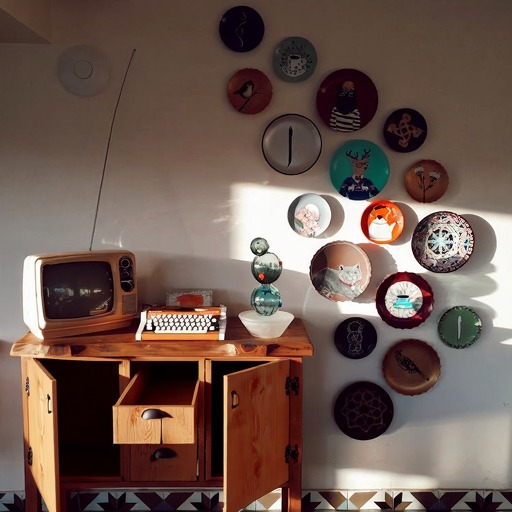
Edited cabinet: both doors and the drawer are open

Click a step to replay it. Photo: Pexels.

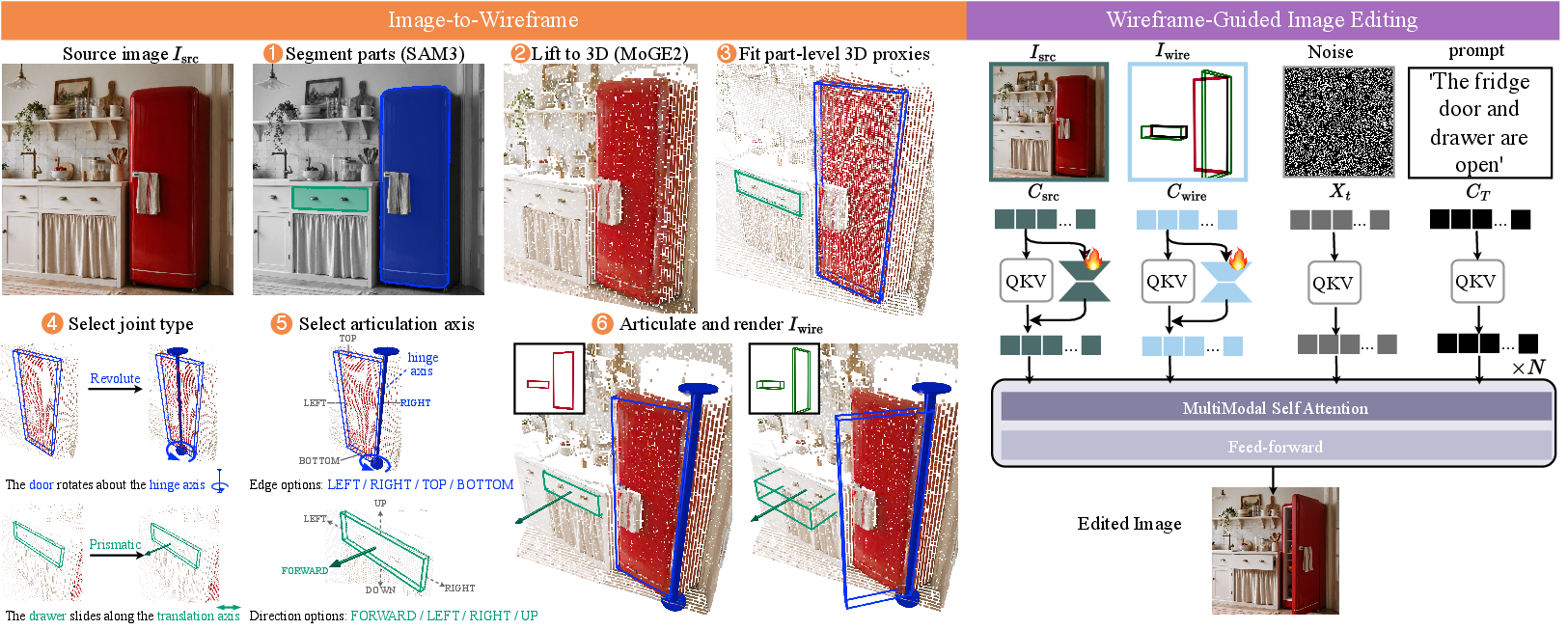
RigIt pipeline: image-to-wireframe on the left (SAM3 segmentation, MoGe2 point map, OBB fitting, joint type and axis selection, articulation, wireframe projection) and wireframe-guided diffusion editing on the right (FLUX mmDiT with condition-specific LoRA modules).

Left (Image-to-Wireframe). Given a source image Isrc, the user selects which parts to articulate; ① SAM3 segments the selected regions and ② MoGe2 lifts the image to a metric point map. ③ For each part, we fit an oriented 3D bounding box that serves as a kinematic proxy. A joint is attached to each proxy by selecting ④ a type (revolute or prismatic) and ⑤ an axis from a small discrete label space, either through a lightweight editor or via a vision–language model. ⑥ The user articulates the proxies to the target state, and we project the source and target proxy edges into the image plane to render the wireframe condition Iwire (insets).

Right (Wireframe-Guided Image Editing). The diffusion model receives Isrc, Iwire, noise, and a text prompt as input. The source image and wireframe are encoded as condition tokens, adapted by condition-specific LoRA modules (orange flames), then concatenated with the noisy latent and text tokens and jointly processed by the FLUX mmDiT blocks to synthesize the edited image.

Results

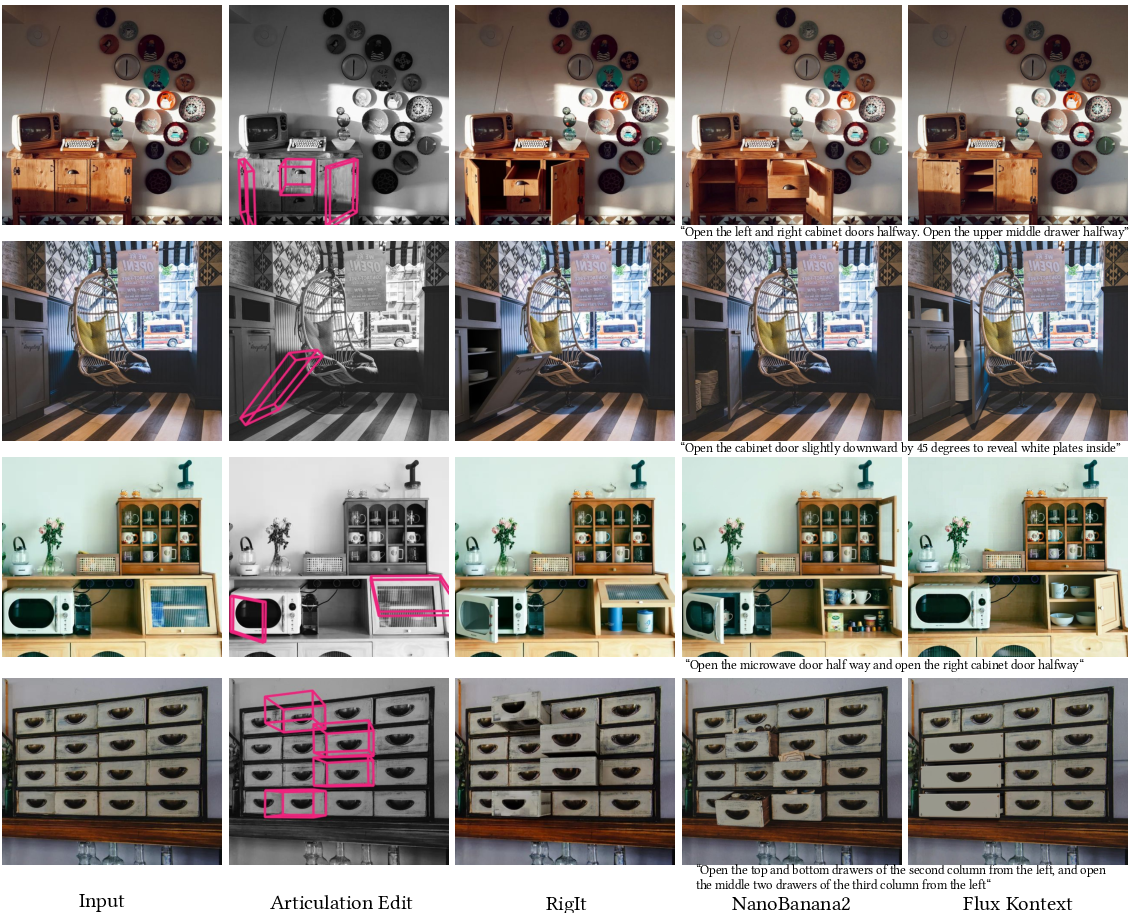
Qualitative comparison against text-based baselines on in-the-wild internet images.

Qualitative comparison against text-based baselines on in-the-wild internet images. For each row, from left to right, we show the original image, articulation wireframe, and results generated by RigIt, Nano Banana 2, and FLUX Kontext.